


Page 214 - Demo
P. 214
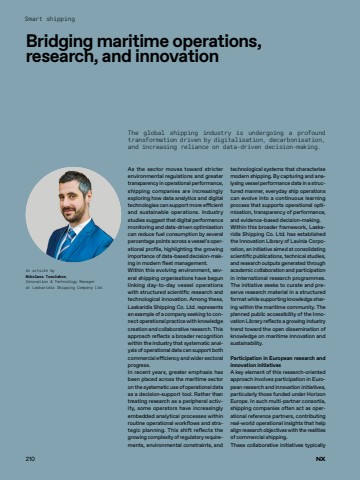
Bridging maritime operations, research, and innovationAs the sector moves toward stricter environmental regulations and greater transparency in operational performance, shipping companies are increasingly exploring how data analytics and digital technologies can support more efficient and sustainable operations. Industry studies suggest that digital performance monitoring and data-driven optimisation can reduce fuel consumption by several percentage points across a vessel%u2019s operational profile, highlighting the growing importance of data-based decision-making in modern fleet management.Within this evolving environment, several shipping organisations have begun linking day-to-day vessel operations with structured scientific research and technological innovation. Among these, Laskaridis Shipping Co. Ltd. represents an example of a company seeking to connect operational practice with knowledge creation and collaborative research. This approach reflects a broader recognition within the industry that systematic analysis of operational data can support both commercial efficiency and wider sectoral progress.In recent years, greater emphasis has been placed across the maritime sector on the systematic use of operational data as a decision-support tool. Rather than treating research as a peripheral activity, some operators have increasingly embedded analytical processes within routine operational workflows and strategic planning. This shift reflects the growing complexity of regulatory requirements, environmental constraints, and technological systems that characterise modern shipping. By capturing and analysing vessel performance data in a structured manner, everyday ship operations can evolve into a continuous learning process that supports operational optimisation, transparency of performance, and evidence-based decision-making.Within this broader framework, Laskaridis Shipping Co. Ltd. has established the Innovation Library of Lavinia Corporation, an initiative aimed at consolidating scientific publications, technical studies, and research outputs generated through academic collaboration and participation in international research programmes. The initiative seeks to curate and preserve research material in a structured format while supporting knowledge sharing within the maritime community. The planned public accessibility of the Innovation Library reflects a growing industry trend toward the open dissemination of knowledge on maritime innovation and sustainability.Participation in European research and innovation initiativesA key element of this research-oriented approach involves participation in European research and innovation initiatives, particularly those funded under Horizon Europe. In such multi-partner consortia, shipping companies often act as operational reference partners, contributing real-world operational insights that help align research objectives with the realities of commercial shipping.These collaborative initiatives typically An article by Nikolaos Tsoulakos, Innovation & Technology Managerat Laskaridis Shipping Company Ltd.The global shipping industry is undergoing a profound transformation driven by digitalisation, decarbonisation, and increasing reliance on data-driven decision-making.Smart shipping210 NX


