


Page 208 - Demo
P. 208
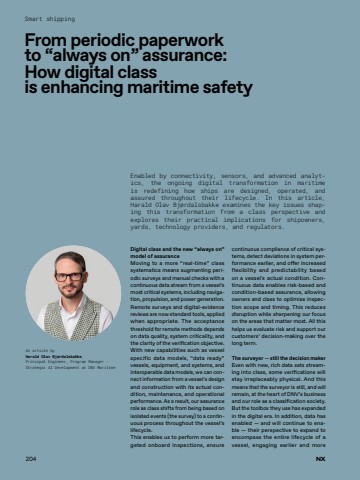
From periodic paperwork to %u201calways on%u201d assurance:How digital classis enhancing maritime safetyDigital class and the new %u201calways on%u201d model of assurance Moving to a more %u201creal-time%u201d class systematics means augmenting periodic surveys and manual checks with a continuous data stream from a vessel%u2019s most critical systems, including navigation, propulsion, and power generation. Remote surveys and digital-evidence reviews are now standard tools, applied when appropriate. The acceptance threshold for remote methods depends on data quality, system criticality, and the clarity of the verification objective.With new capabilities such as vessel specific data models, %u201cdata ready%u201d vessels, equipment, and systems, and interoperable data models, we can connect information from a vessel%u2019s design and construction with its actual condition, maintenance, and operational performance. As a result, our assurance role as class shifts from being based on isolated events (the survey) to a continuous process throughout the vessel%u2019s lifecycle.This enables us to perform more targeted onboard inspections, ensure continuous compliance of critical systems, detect deviations in system performance earlier, and offer increased flexibility and predictability based on a vessel's actual condition. Continuous data enables risk-based and condition-based assurance, allowing owners and class to optimise inspection scope and timing. This reduces disruption while sharpening our focus on the areas that matter most. All this helps us evaluate risk and support our customers%u2019 decision-making over the long term.The surveyor %u2014 still the decision maker Even with new, rich data sets streaming into class, some verifications will stay irreplaceably physical. And this means that the surveyor is still, and will remain, at the heart of DNV%u2019s business and our role as a classification society. But the toolbox they use has expanded in the digital era. In addition, data has enabled %u2014 and will continue to enable %u2014 their perspective to expand to encompass the entire lifecycle of a vessel, engaging earlier and more An article by Harald Olav Bj%u00f8rdalsbakke, Principal Engineer, Program Manager - Strategic AI Development at DNV MaritimeEnabled by connectivity, sensors, and advanced analytics, the ongoing digital transformation in maritime is redefining how ships are designed, operated, and assured throughout their lifecycle. In this article, Harald Olav Bj%u00f8rdalsbakke examines the key issues shaping this transformation from a class perspective and explores their practical implications for shipowners, yards, technology providers, and regulators.Smart shipping204 NX


