


Page 204 - Demo
P. 204
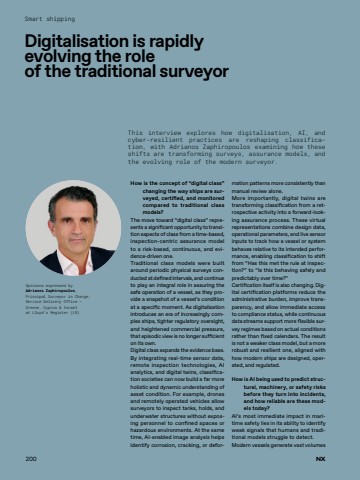
Digitalisation is rapidly evolving the role of the traditional surveyorHow is the concept of %u201cdigital class%u201d changing the way ships are surveyed, certified, and monitored compared to traditional class models?The move toward %u201cdigital class%u201d represents a significant opportunity to transition aspects of class from a time-based, inspection-centric assurance model to a risk-based, continuous, and evidence-driven one.Traditional class models were built around periodic physical surveys conducted at defined intervals, and continue to play an integral role in assuring the safe operation of a vessel, as they provide a snapshot of a vessel%u2019s condition at a specific moment. As digitalisation introduces an era of increasingly complex ships, tighter regulatory oversight, and heightened commercial pressure, that episodic view is no longer sufficient on its own.Digital class expands the evidence base. By integrating real-time sensor data, remote inspection technologies, AI analytics, and digital twins, classification societies can now build a far more holistic and dynamic understanding of asset condition. For example, drones and remotely operated vehicles allow surveyors to inspect tanks, holds, and underwater structures without exposing personnel to confined spaces or hazardous environments. At the same time, AI-enabled image analysis helps identify corrosion, cracking, or deformation patterns more consistently than manual review alone. More importantly, digital twins are transforming classification from a retrospective activity into a forward-looking assurance process. These virtual representations combine design data, operational parameters, and live sensor inputs to track how a vessel or system behaves relative to its intended performance, enabling classification to shift from %u201cHas this met the rule at inspection?%u201d to %u201cIs this behaving safely and predictably over time?%u201d Certification itself is also changing. Digital certification platforms reduce the administrative burden, improve transparency, and allow immediate access to compliance status, while continuous data streams support more flexible survey regimes based on actual conditions rather than fixed calendars. The result is not a weaker class model, but a more robust and resilient one, aligned with how modern ships are designed, operated, and regulated.How is AI being used to predict structural, machinery, or safety risks before they turn into incidents, and how reliable are these models today?AI%u2019s most immediate impact in maritime safety lies in its ability to identify weak signals that humans and traditional models struggle to detect.Modern vessels generate vast volumes Opinions expressed by Adrianos Zaphiropoulos, Principal Surveyor in Charge, Service Delivery Office %u2013Greece, Cyprus & Israelat Lloyd's Register (LR)Smart shippingThis interview explores how digitalisation, AI, and cyber-resilient practices are reshaping classification, with Adrianos Zaphiropoulos examining how these shifts are transforming surveys, assurance models, and the evolving role of the modern surveyor.200 NX


