


Page 200 - Demo
P. 200
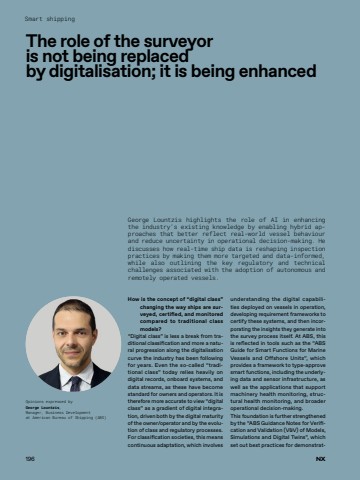
The role of the surveyoris not being replaced by digitalisation; it is being enhancedHow is the concept of %u201cdigital class%u201d changing the way ships are surveyed, certified, and monitored compared to traditional class models?%u201cDigital class%u201d is less a break from traditional classification and more a natural progression along the digitalisation curve the industry has been following for years. Even the so-called %u201ctraditional class%u201d today relies heavily on digital records, onboard systems, and data streams, as these have become standard for owners and operators. It is therefore more accurate to view %u201cdigital class%u201d as a gradient of digital integration, driven both by the digital maturity of the owner/operator and by the evolution of class and regulatory processes.For classification societies, this means continuous adaptation, which involves understanding the digital capabilities deployed on vessels in operation, developing requirement frameworks to certify these systems, and then incorporating the insights they generate into the survey process itself. At ABS, this is reflected in tools such as the %u201cABS Guide for Smart Functions for Marine Vessels and Offshore Units%u201d, which provides a framework to type-approve smart functions, including the underlying data and sensor infrastructure, as well as the applications that support machinery health monitoring, structural health monitoring, and broader operational decision-making.This foundation is further strengthened by the %u201cABS Guidance Notes for Verification and Validation (V&V) of Models, Simulations and Digital Twins%u201d, which set out best practices for demonstratOpinions expressed by George Lountzis, Manager, Business Development at American Bureau of Shipping (ABS)Smart shippingGeorge Lountzis highlights the role of AI in enhancing the industry%u2019s existing knowledge by enabling hybrid approaches that better reflect real-world vessel behaviour and reduce uncertainty in operational decision-making. He discusses how real-time ship data is reshaping inspection practices by making them more targeted and data-informed, while also outlining the key regulatory and technical challenges associated with the adoption of autonomous and remotely operated vessels.196 NX


