


Page 198 - Demo
P. 198
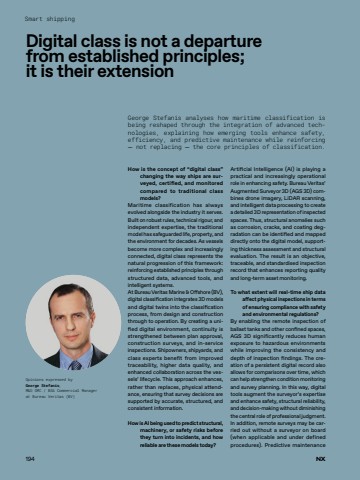
Digital class is not a departure from established principles;it is their extensionHow is the concept of %u201cdigital class%u201d changing the way ships are surveyed, certified, and monitored compared to traditional class models?Maritime classification has always evolved alongside the industry it serves. Built on robust rules, technical rigour, and independent expertise, the traditional model has safeguarded life, property, and the environment for decades. As vessels become more complex and increasingly connected, digital class represents the natural progression of this framework: reinforcing established principles through structured data, advanced tools, and intelligent systems.At Bureau Veritas Marine & Offshore (BV), digital classification integrates 3D models and digital twins into the classification process, from design and construction through to operation. By creating a unified digital environment, continuity is strengthened between plan approval, construction surveys, and in-service inspections. Shipowners, shipyards, and class experts benefit from improved traceability, higher data quality, and enhanced collaboration across the vessels%u2019 lifecycle. This approach enhances, rather than replaces, physical attendance, ensuring that survey decisions are supported by accurate, structured, and consistent information.How is AI being used to predict structural, machinery, or safety risks before they turn into incidents, and how reliable are these models today?Artificial Intelligence (AI) is playing a practical and increasingly operational role in enhancing safety. Bureau Veritas%u2019 Augmented Surveyor 3D (AGS 3D) combines drone imagery, LiDAR scanning, and intelligent data processing to create a detailed 3D representation of inspected spaces. Thus, structural anomalies such as corrosion, cracks, and coating degradation can be identified and mapped directly onto the digital model, supporting thickness assessment and structural evaluation. The result is an objective, traceable, and standardised inspection record that enhances reporting quality and long-term asset monitoring.To what extent will real-time ship data affect physical inspections in terms of ensuring compliance with safety and environmental regulations?By enabling the remote inspection of ballast tanks and other confined spaces, AGS 3D significantly reduces human exposure to hazardous environments while improving the consistency and depth of inspection findings. The creation of a persistent digital record also allows for comparisons over time, which can help strengthen condition monitoring and survey planning. In this way, digital tools augment the surveyor%u2019s expertise and enhance safety, structural reliability, and decision-making without diminishing the central role of professional judgment.In addition, remote surveys may be carried out without a surveyor on board (when applicable and under defined procedures). Predictive maintenance Opinions expressed by George Stefanis, M&O GMC / BSA Commercial Managerat Bureau Veritas (BV)George Stefanis analyses how maritime classification is being reshaped through the integration of advanced technologies, explaining how emerging tools enhance safety, efficiency, and predictive maintenance while reinforcing %u2014 not replacing %u2014 the core principles of classification.Smart shipping194 NX


