


Page 212 - Demo
P. 212
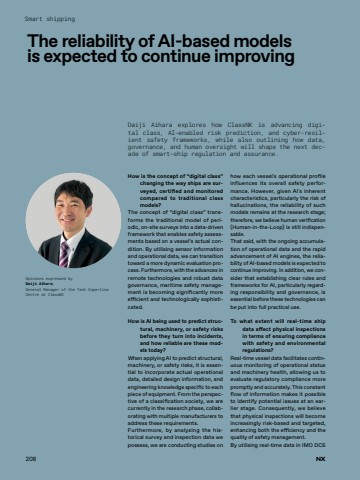
%u03a4he reliability of AI-based models is expected to continue improvingHow is the concept of %u201cdigital class%u201d changing the way ships are surveyed, certified and monitored compared to traditional class models?The concept of %u201cdigital class%u201d transforms the traditional model of periodic, on-site surveys into a data-driven framework that enables safety assessments based on a vessel%u2019s actual condition. By utilising sensor information and operational data, we can transition toward a more dynamic evaluation process. Furthermore, with the advances in remote technologies and robust data governance, maritime safety management is becoming significantly more efficient and technologically sophisticated.How is AI being used to predict structural, machinery, or safety risks before they turn into incidents, and how reliable are these models today?When applying AI to predict structural, machinery, or safety risks, it is essential to incorporate actual operational data, detailed design information, and engineering knowledge specific to each piece of equipment. From the perspective of a classification society, we are currently in the research phase, collaborating with multiple manufacturers to address these requirements.Furthermore, by analysing the historical survey and inspection data we possess, we are conducting studies on how each vessel's operational profile influences its overall safety performance. However, given AI's inherent characteristics, particularly the risk of hallucinations, the reliability of such models remains at the research stage; therefore, we believe human verification (Human-in-the-Loop) is still indispensable.That said, with the ongoing accumulation of operational data and the rapid advancement of AI engines, the reliability of AI-based models is expected to continue improving. In addition, we consider that establishing clear rules and frameworks for AI, particularly regarding responsibility and governance, is essential before these technologies can be put into full practical use.To what extent will real-time ship data affect physical inspections in terms of ensuring compliance with safety and environmental regulations?Real-time vessel data facilitates continuous monitoring of operational status and machinery health, allowing us to evaluate regulatory compliance more promptly and accurately. This constant flow of information makes it possible to identify potential issues at an earlier stage. Consequently, we believe that physical inspections will become increasingly risk-based and targeted, enhancing both the efficiency and the quality of safety management.By utilising real-time data in IMO DCS Opinions expressed by Daiji Aihara,General Manager of the Tech Expertise Centre at ClassNKSmart shippingDaiji Aihara explores how ClassNK is advancing digital class, AI-enabled risk prediction, and cyber-resilient safety frameworks, while also outlining how data, governance, and human oversight will shape the next decade of smart-ship regulation and assurance.208 NX


