


Page 216 - Demo
P. 216
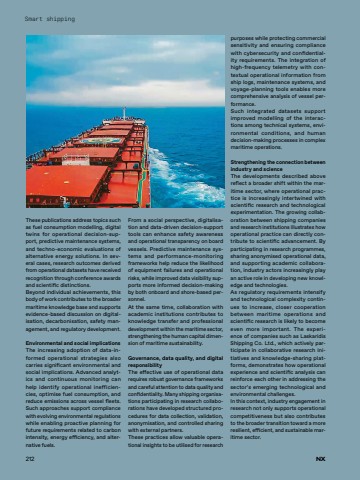
These publications address topics such as fuel consumption modelling, digital twins for operational decision-support, predictive maintenance systems, and techno-economic evaluations of alternative energy solutions. In several cases, research outcomes derived from operational datasets have received recognition through conference awards and scientific distinctions.Beyond individual achievements, this body of work contributes to the broader maritime knowledge base and supports evidence-based discussion on digitalisation, decarbonisation, safety management, and regulatory development.Environmental and social implicationsThe increasing adoption of data-informed operational strategies also carries significant environmental and social implications. Advanced analytics and continuous monitoring can help identify operational inefficiencies, optimise fuel consumption, and reduce emissions across vessel fleets. Such approaches support compliance with evolving environmental regulations while enabling proactive planning for future requirements related to carbon intensity, energy efficiency, and alternative fuels.From a social perspective, digitalisation and data-driven decision-support tools can enhance safety awareness and operational transparency on board vessels. Predictive maintenance systems and performance-monitoring frameworks help reduce the likelihood of equipment failures and operational risks, while improved data visibility supports more informed decision-making by both onboard and shore-based personnel.At the same time, collaboration with academic institutions contributes to knowledge transfer and professional development within the maritime sector, strengthening the human capital dimension of maritime sustainability.Governance, data quality, and digital responsibilityThe effective use of operational data requires robust governance frameworks and careful attention to data quality and confidentiality. Many shipping organisations participating in research collaborations have developed structured procedures for data collection, validation, anonymisation, and controlled sharing with external partners.These practices allow valuable operational insights to be utilised for research purposes while protecting commercial sensitivity and ensuring compliance with cybersecurity and confidentiality requirements. The integration of high-frequency telemetry with contextual operational information from ship logs, maintenance systems, and voyage-planning tools enables more comprehensive analysis of vessel performance.Such integrated datasets support improved modelling of the interactions among technical systems, environmental conditions, and human decision-making processes in complex maritime operations.Strengthening the connection between industry and scienceThe developments described above reflect a broader shift within the maritime sector, where operational practice is increasingly intertwined with scientific research and technological experimentation. The growing collaboration between shipping companies and research institutions illustrates how operational practice can directly contribute to scientific advancement. By participating in research programmes, sharing anonymised operational data, and supporting academic collaboration, industry actors increasingly play an active role in developing new knowledge and technologies.As regulatory requirements intensify and technological complexity continues to increase, closer cooperation between maritime operations and scientific research is likely to become even more important. The experience of companies such as Laskaridis Shipping Co. Ltd., which actively participate in collaborative research initiatives and knowledge-sharing platforms, demonstrates how operational experience and scientific analysis can reinforce each other in addressing the sector%u2019s emerging technological and environmental challenges.In this context, industry engagement in research not only supports operational competitiveness but also contributes to the broader transition toward a more resilient, efficient, and sustainable maritime sector.Smart shipping212 NX


