


Page 210 - Demo
P. 210
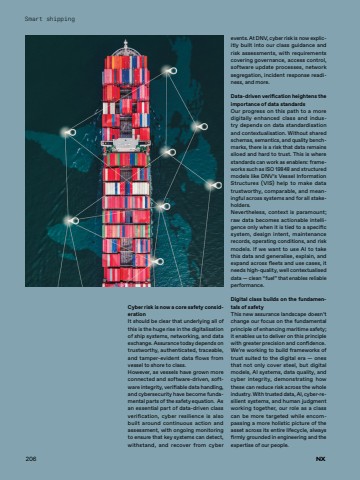
Cyber risk is now a core safety considerationIt should be clear that underlying all of this is the huge rise in the digitalisation of ship systems, networking, and data exchange. Assurance today depends on trustworthy, authenticated, traceable, and tamper-evident data flows from vessel to shore to class.However, as vessels have grown more connected and software-driven, software integrity, verifiable data handling, and cybersecurity have become fundamental parts of the safety equation. As an essential part of data-driven class verification, cyber resilience is also built around continuous action and assessment, with ongoing monitoring to ensure that key systems can detect, withstand, and recover from cyber events. At DNV, cyber risk is now explicitly built into our class guidance and risk assessments, with requirements covering governance, access control, software update processes, network segregation, incident response readiness, and more.Data-driven verification heightens the importance of data standards Our progress on this path to a more digitally enhanced class and industry depends on data standardisation and contextualisation. Without shared schemas, semantics, and quality benchmarks, there is a risk that data remains siloed and hard to trust. This is where standards can work as enablers: frameworks such as ISO 19848 and structured models like DNV%u2019s Vessel Information Structures (VIS) help to make data trustworthy, comparable, and meaningful across systems and for all stakeholders. Nevertheless, context is paramount; raw data becomes actionable intelligence only when it is tied to a specific system, design intent, maintenance records, operating conditions, and risk models. If we want to use AI to take this data and generalise, explain, and expand across fleets and use cases, it needs high-quality, well contextualised data %u2014 clean %u201cfuel%u201d that enables reliable performance.Digital class builds on the fundamentals of safetyThis new assurance landscape doesn%u2019t change our focus on the fundamental principle of enhancing maritime safety; it enables us to deliver on this principle with greater precision and confidence. We%u2019re working to build frameworks of trust suited to the digital era %u2014 ones that not only cover steel, but digital models, AI systems, data quality, and cyber integrity, demonstrating how these can reduce risk across the whole industry. With trusted data, AI, cyber-resilient systems, and human judgment working together, our role as a class can be more targeted while encompassing a more holistic picture of the asset across its entire lifecycle, always firmly grounded in engineering and the expertise of our people.Smart shipping206 NX


