


Page 330 - Demo
P. 330
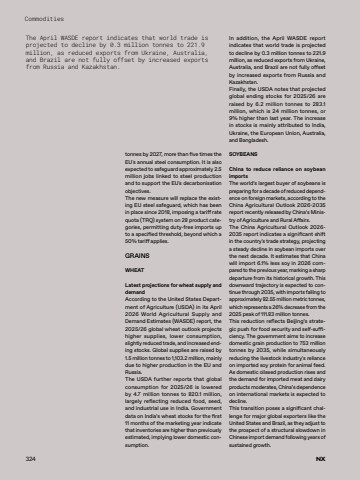
tonnes by 2027, more than five times the EU's annual steel consumption. It is also expected to safeguard approximately 2.5 million jobs linked to steel production and to support the EU's decarbonisation objectives.The new measure will replace the existing EU steel safeguard, which has been in place since 2018, imposing a tariff rate quota (TRQ) system on 28 product categories, permitting duty-free imports up to a specified threshold, beyond which a 50% tariff applies.GRAINSWHEATLatest projections for wheat supply and demandAccording to the United States Department of Agriculture (USDA) in its April 2026 World Agricultural Supply and Demand Estimates (WASDE) report, the 2025/26 global wheat outlook projects higher supplies, lower consumption, slightly reduced trade, and increased ending stocks. Global supplies are raised by 1.5 million tonnes to 1,103.2 million, mainly due to higher production in the EU and Russia.The USDA further reports that global consumption for 2025/26 is lowered by 4.7 million tonnes to 820.1 million, largely reflecting reduced food, seed, and industrial use in India. Government data on India%u2019s wheat stocks for the first 11 months of the marketing year indicate that inventories are higher than previously estimated, implying lower domestic consumption.In addition, the April WASDE report indicates that world trade is projected to decline by 0.3 million tonnes to 221.9 million, as reduced exports from Ukraine, Australia, and Brazil are not fully offset by increased exports from Russia and Kazakhstan.Finally, the USDA notes that projected global ending stocks for 2025/26 are raised by 6.2 million tonnes to 283.1 million, which is 24 million tonnes, or 9% higher than last year. The increase in stocks is mainly attributed to India, Ukraine, the European Union, Australia, and Bangladesh.SOYBEANSChina to reduce reliance on soybean importsThe world%u2019s largest buyer of soybeans is preparing for a decade of reduced dependence on foreign markets, according to the China Agricultural Outlook 2026-2035 report recently released by China%u2019s Ministry of Agriculture and Rural Affairs.The China Agricultural Outlook 2026-2035 report indicates a significant shift in the country's trade strategy, projecting a steady decline in soybean imports over the next decade. It estimates that China will import 6.1% less soy in 2026 compared to the previous year, marking a sharp departure from its historical growth. This downward trajectory is expected to continue through 2035, with imports falling to approximately 82.55 million metric tonnes, which represents a 26% decrease from the 2025 peak of 111.83 million tonnes.This reduction reflects Beijing%u2019s strategic push for food security and self-sufficiency. The government aims to increase domestic grain production to 753 million tonnes by 2035, while simultaneously reducing the livestock industry's reliance on imported soy protein for animal feed. As domestic oilseed production rises and the demand for imported meat and dairy products moderates, China%u2019s dependence on international markets is expected to decline. This transition poses a significant challenge for major global exporters like the United States and Brazil, as they adjust to the prospect of a structural slowdown in Chinese import demand following years of sustained growth.The April WASDE report indicates that world trade is projected to decline by 0.3 million tonnes to 221.9million, as reduced exports from Ukraine, Australia, and Brazil are not fully offset by increased exports from Russia and Kazakhstan.Commodities324 NX


