


Page 327 - Demo
P. 327
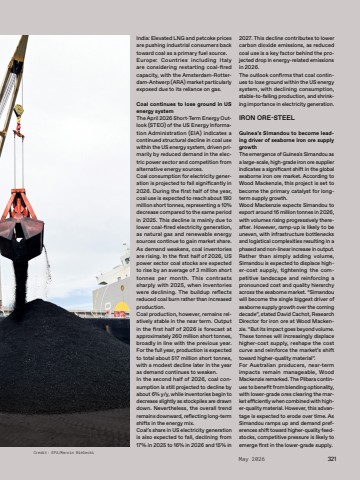
India: Elevated LNG and petcoke prices are pushing industrial consumers back toward coal as a primary fuel source. Europe: Countries including Italy are considering restarting coal-fired capacity, with the Amsterdam-Rotterdam-Antwerp (ARA) market particularly exposed due to its reliance on gas.Coal continues to lose ground in US energy systemThe April 2026 Short-Term Energy Outlook (STEO) of the US Energy Information Administration (EIA) indicates a continued structural decline in coal use within the US energy system, driven primarily by reduced demand in the electric power sector and competition from alternative energy sources.Coal consumption for electricity generation is projected to fall significantly in 2026. During the first half of the year, coal use is expected to reach about 180 million short tonnes, representing a 10% decrease compared to the same period in 2025. This decline is mainly due to lower coal-fired electricity generation, as natural gas and renewable energy sources continue to gain market share.As demand weakens, coal inventories are rising. In the first half of 2026, US power sector coal stocks are expected to rise by an average of 3 million short tonnes per month. This contrasts sharply with 2025, when inventories were declining. The buildup reflects reduced coal burn rather than increased production.Coal production, however, remains relatively stable in the near term. Output in the first half of 2026 is forecast at approximately 260 million short tonnes, broadly in line with the previous year. For the full year, production is expected to total about 517 million short tonnes, with a modest decline later in the year as demand continues to weaken.In the second half of 2026, coal consumption is still projected to decline by about 6% y/y, while inventories begin to decrease slightly as stockpiles are drawn down. Nevertheless, the overall trend remains downward, reflecting long-term shifts in the energy mix.Coal%u2019s share in US electricity generation is also expected to fall, declining from 17% in 2025 to 16% in 2026 and 15% in 2027. This decline contributes to lower carbon dioxide emissions, as reduced coal use is a key factor behind the projected drop in energy-related emissions in 2026.The outlook confirms that coal continues to lose ground within the US energy system, with declining consumption, stable-to-falling production, and shrinking importance in electricity generation.IRON ORE-STEELGuinea%u2019s Simandou to become leading driver of seaborne iron ore supply growthThe emergence of Guinea's Simandou as a large-scale, high-grade iron ore supplier indicates a significant shift in the global seaborne iron ore market. According to Wood Mackenzie, this project is set to become the primary catalyst for longterm supply growth.Wood Mackenzie expects Simandou to export around 16 million tonnes in 2026, with volumes rising progressively thereafter. However, ramp-up is likely to be uneven, with infrastructure bottlenecks and logistical complexities resulting in a phased and non-linear increase in output.Rather than simply adding volume, Simandou is expected to displace higher-cost supply, tightening the competitive landscape and reinforcing a pronounced cost and quality hierarchy across the seaborne market. %u201cSimandou will become the single biggest driver of seaborne supply growth over the coming decade%u201d, stated David Cachot, Research Director for iron ore at Wood Mackenzie. %u201cBut its impact goes beyond volume. These tonnes will increasingly displace higher-cost supply, reshape the cost curve and reinforce the market%u2019s shift toward higher-quality material%u201d.For Australian producers, near-term impacts remain manageable, Wood Mackenzie remarked. The Pilbara continues to benefit from blending optionality, with lower-grade ores clearing the market efficiently when combined with higher-quality material. However, this advantage is expected to erode over time. As Simandou ramps up and demand preferences shift toward higher-quality feedstocks, competitive pressure is likely to emerge first in the lower-grade supply. Credit: EPA/Marcin BieleckiMay 2026 321


