


Page 139 - Demo
P. 139
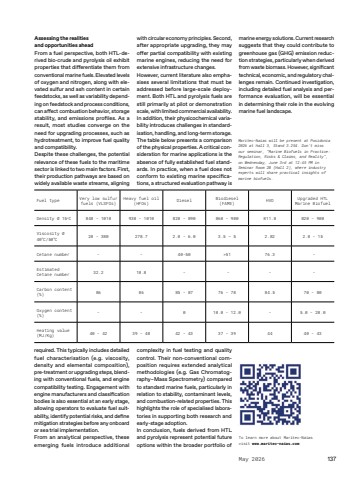
Fuel type Very low sulfur fuels (VLSFOs) Heavy fuel oil (HFOs) Diesel Biodiesel (FAME) HVO Upgraded HTL Marine BiofuelDensity @ 15oC 840 - 1010 930 - 1010 820 - 890 860 - 900 811.8 820 - 900Viscosity @40oC/50oC 20 - 380 278.7 2.0 - 6.0 3.5 %u2013 5 2.82 2.0 - 15Cetane number - - 40-50 >51 76.3 -EstimatedCetane number 32.2 18.8 - - - -Carbon content (%) 86 86 85 - 87 76 - 78 84.5 70 - 80Oxygen content (%) - - 0 10.0 - 12.0 - 5.0 - 20.0Heating value (MJ/Kg) 40 - 42 39 - 40 42 - 43 37 - 39 44 40 - 43To learn more about Maritec-Naias visit www.maritec-naias.comAssessing the realitiesand opportunities aheadFrom a fuel perspective, both HTL-derived bio-crude and pyrolysis oil exhibit properties that differentiate them from conventional marine fuels. Elevated levels of oxygen and nitrogen, along with elevated sulfur and ash content in certain feedstocks, as well as variability depending on feedstock and process conditions, can affect combustion behavior, storage stability, and emissions profiles. As a result, most studies converge on the need for upgrading processes, such as hydrotreatment, to improve fuel quality and compatibility.Despite these challenges, the potential relevance of these fuels to the maritime sector is linked to two main factors. First, their production pathways are based on widely available waste streams, aligning with circular economy principles. Second, after appropriate upgrading, they may offer partial compatibility with existing marine engines, reducing the need for extensive infrastructure changes.However, current literature also emphasises several limitations that must be addressed before large-scale deployment. Both HTL and pyrolysis fuels are still primarily at pilot or demonstration scale, with limited commercial availability. In addition, their physicochemical variability introduces challenges in standardisation, handling, and long-term storage.The table below presents a comparison of the physical properties. A critical consideration for marine applications is the absence of fully established fuel standards. In practice, when a fuel does not conform to existing marine specifications, a structured evaluation pathway is required. This typically includes detailed fuel characterisation (e.g. viscosity, density and elemental composition), pre-treatment or upgrading steps, blending with conventional fuels, and engine compatibility testing. Engagement with engine manufacturers and classification bodies is also essential at an early stage, allowing operators to evaluate fuel suitability, identify potential risks, and define mitigation strategies before any onboard or sea trial implementation.From an analytical perspective, these emerging fuels introduce additional complexity in fuel testing and quality control. Their non-conventional composition requires extended analytical methodologies (e.g. Gas Chromatography%u2013Mass Spectrometry) compared to standard marine fuels, particularly in relation to stability, contaminant levels, and combustion-related properties. This highlights the role of specialised laboratories in supporting both research and early-stage adoption.In conclusion, fuels derived from HTL and pyrolysis represent potential future options within the broader portfolio of marine energy solutions. Current research suggests that they could contribute to greenhouse gas (GHG) emission reduction strategies, particularly when derived from waste biomass. However, significant technical, economic, and regulatory challenges remain. Continued investigation, including detailed fuel analysis and performance evaluation, will be essential in determining their role in the evolving marine fuel landscape.Maritec-Naias will be present at Posidonia 2026 at Hall 3, Stand 3.254. Don%u2019t miss our seminar, %u201cMarine Biofuels in Practice: Regulation, Risks & Claims, and Reality%u201d, on Wednesday, June 3rd at 12:45 PM in Seminar Room 2B (Hall 2), where industry experts will share practical insights of marine biofuels.May 2026 137


