


Page 138 - Demo
P. 138
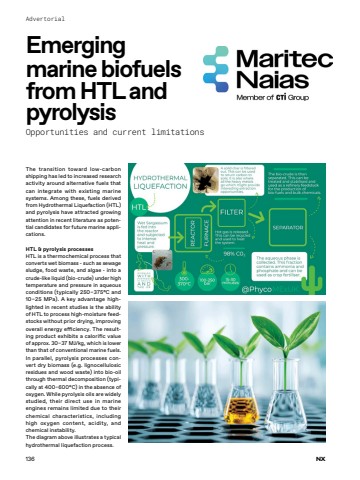
Emerging marine biofuels from HTL and pyrolysis The transition toward low-carbon shipping has led to increased research activity around alternative fuels that can integrate with existing marine systems. Among these, fuels derived from Hydrothermal Liquefaction (HTL) and pyrolysis have attracted growing attention in recent literature as potential candidates for future marine applications.HTL & pyrolysis processesHTL is a thermochemical process that converts wet biomass - such as sewage sludge, food waste, and algae - into a crude-like liquid (bio-crude) under high temperature and pressure in aqueous conditions (typically 250%u2013375%u00b0C and 10%u201325 MPa). A key advantage highlighted in recent studies is the ability of HTL to process high-moisture feedstocks without prior drying, improving overall energy efficiency. The resulting product exhibits a calorific value of approx. 30%u201337 MJ/kg, which is lower than that of conventional marine fuels. In parallel, pyrolysis processes convert dry biomass (e.g. lignocellulosic residues and wood waste) into bio-oil through thermal decomposition (typically at 400%u2013600%u00b0C) in the absence of oxygen. While pyrolysis oils are widely studied, their direct use in marine engines remains limited due to their chemical characteristics, including high oxygen content, acidity, and chemical instability. The diagram above illustrates a typical hydrothermal liquefaction process. Opportunities and current limitationsAdvertorial136 NX


