


Page 136 - Demo
P. 136
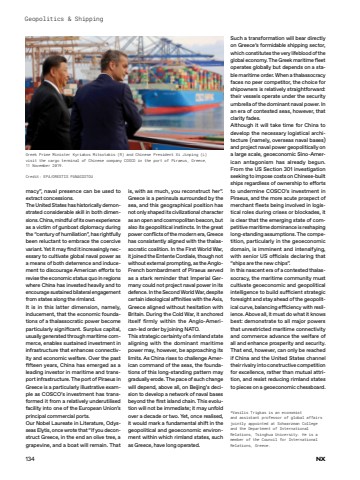
macy%u201d, naval presence can be used to extract concessions.The United States has historically demonstrated considerable skill in both dimensions. China, mindful of its own experience as a victim of gunboat diplomacy during the %u201ccentury of humiliation%u201d, has rightfully been reluctant to embrace the coercive variant. Yet it may find it increasingly necessary to cultivate global naval power as a means of both deterrence and inducement to discourage American efforts to revise the economic status quo in regions where China has invested heavily and to encourage sustained bilateral engagement from states along the rimland.It is in this latter dimension, namely, inducement, that the economic foundations of a thalassocratic power become particularly significant. Surplus capital, usually generated through maritime commerce, enables sustained investment in infrastructure that enhances connectivity and economic welfare. Over the past fifteen years, China has emerged as a leading investor in maritime and transport infrastructure. The port of Piraeus in Greece is a particularly illustrative example as COSCO%u2019s investment has transformed it from a relatively underutilised facility into one of the European Union%u2019s principal commercial ports.Our Nobel Laureate in Literature, Odysseas Elytis, once wrote that %u201cIf you deconstruct Greece, in the end an olive tree, a grapevine, and a boat will remain. That is, with as much, you reconstruct her%u201d. Greece is a peninsula surrounded by the sea, and this geographical position has not only shaped its civilizational character as an open and cosmopolitan beacon, but also its geopolitical instincts. In the great power conflicts of the modern era, Greece has consistently aligned with the thalassocratic coalition. In the First World War, it joined the Entente Cordiale, though not without external prompting, as the AngloFrench bombardment of Piraeus served as a stark reminder that Imperial Germany could not project naval power in its defence. In the Second World War, despite certain ideological affinities with the Axis, Greece aligned without hesitation with Britain. During the Cold War, it anchored itself firmly within the Anglo-American-led order by joining NATO.This strategic certainty of a rimland state aligning with the dominant maritime power may, however, be approaching its limits. As China rises to challenge American command of the seas, the foundations of this long-standing pattern may gradually erode. The pace of such change will depend, above all, on Beijing%u2019s decision to develop a network of naval bases beyond the first island chain. This evolution will not be immediate; it may unfold over a decade or two. Yet, once realised, it would mark a fundamental shift in the geopolitical and geoeconomic environment within which rimland states, such as Greece, have long operated. Such a transformation will bear directly on Greece%u2019s formidable shipping sector, which constitutes the very lifeblood of the global economy. The Greek maritime fleet operates globally but depends on a stable maritime order. When a thalassocracy faces no peer competitor, the choice for shipowners is relatively straightforward: their vessels operate under the security umbrella of the dominant naval power. In an era of contested seas, however, that clarity fades.Although it will take time for China to develop the necessary logistical architecture (namely, overseas naval bases) and project naval power geopolitically on a large scale, geoeconomic Sino-American antagonism has already begun. From the US Section 301 investigation seeking to impose costs on Chinese-built ships regardless of ownership to efforts to undermine COSCO%u2019s investment in Piraeus, and the more acute prospect of merchant fleets being involved in logistical roles during crises or blockades, it is clear that the emerging state of competitive maritime dominance is reshaping long-standing assumptions. The competition, particularly in the geoeconomic domain, is imminent and intensifying, with senior US officials declaring that %u201cships are the new chips%u201d.In this nascent era of a contested thalassocracy, the maritime community must cultivate geoeconomic and geopolitical intelligence to build sufficient strategic foresight and stay ahead of the geopolitical curve, balancing efficiency with resilience. Above all, it must do what it knows best: demonstrate to all major powers that unrestricted maritime connectivity and commerce advance the welfare of all and enhance prosperity and security. That end, however, can only be reached if China and the United States channel their rivalry into constructive competition for excellence, rather than mutual attrition, and resist reducing rimland states to pieces on a geoeconomic chessboard.Greek Prime Minister Kyriakos Mitsotakis (R) and Chinese President Xi Jinping (L) visit the cargo terminal of Chinese company COSCO in the port of Piraeus, Greece, 11 November 2019.Credit: EPA/ORESTIS PANAGIOTOUGeopolitics & Shipping*Vasilis Trigkas is an economist and assistant professor of global affairs jointly appointed at Schwarzman College and the Department of International Relations, Tsinghua University. He is a member of the Council for International Relations, Greece.134 NX


