


Page 135 - Demo
P. 135
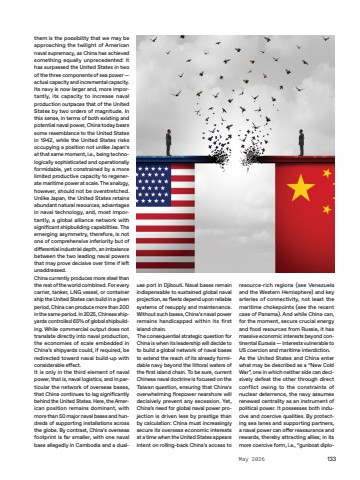
them is the possibility that we may be approaching the twilight of American naval supremacy, as China has achieved something equally unprecedented: it has surpassed the United States in two of the three components of sea power %u2014 actual capacity and incremental capacity. Its navy is now larger and, more importantly, its capacity to increase naval production outpaces that of the United States by two orders of magnitude. In this sense, in terms of both existing and potential naval power, China today bears some resemblance to the United States in 1942, while the United States risks occupying a position not unlike Japan%u2019s at that same moment, i.e., being technologically sophisticated and operationally formidable, yet constrained by a more limited productive capacity to regenerate maritime power at scale. The analogy, however, should not be overstretched. Unlike Japan, the United States retains abundant natural resources, advantages in naval technology, and, most importantly, a global alliance network with significant shipbuilding capabilities. The emerging asymmetry, therefore, is not one of comprehensive inferiority but of differential industrial depth, an imbalance between the two leading naval powers that may prove decisive over time if left unaddressed.China currently produces more steel than the rest of the world combined. For every carrier, tanker, LNG vessel, or container ship the United States can build in a given period, China can produce more than 200 in the same period. In 2025, Chinese shipyards controlled 65% of global shipbuilding. While commercial output does not translate directly into naval production, the economies of scale embedded in China%u2019s shipyards could, if required, be redirected toward naval build-up with considerable effect. It is only in the third element of naval power, that is, naval logistics, and in particular the network of overseas bases, that China continues to lag significantly behind the United States. Here, the American position remains dominant, with more than 50 major naval bases and hundreds of supporting installations across the globe. By contrast, China%u2019s overseas footprint is far smaller, with one naval base allegedly in Cambodia and a dualuse port in Djibouti. Naval bases remain indispensable to sustained global naval projection, as fleets depend upon reliable systems of resupply and maintenance. Without such bases, China%u2019s naval power remains handicapped within its first island chain. The consequential strategic question for China is when its leadership will decide to to build a global network of naval bases to extend the reach of its already formidable navy beyond the littoral waters of the first island chain. To be sure, current Chinese naval doctrine is focused on the Taiwan question, ensuring that China%u2019s overwhelming firepower nearshore will decisively prevent any secession. Yet, China%u2019s need for global naval power projection is driven less by prestige than by calculation: China must increasingly secure its overseas economic interests at a time when the United States appears intent on rolling-back China%u2019s access to resource-rich regions (see Venezuela and the Western Hemisphere) and key arteries of connectivity, not least the maritime chokepoints (see the recent case of Panama). And while China can, for the moment, secure crucial energy and food resources from Russia, it has massive economic interests beyond continental Eurasia %u2014 interests vulnerable to US coercion and maritime interdiction. As the United States and China enter what may be described as a %u201cNew Cold War%u201d, one in which neither side can decisively defeat the other through direct conflict owing to the constraints of nuclear deterrence, the navy assumes renewed centrality as an instrument of political power. It possesses both inducive and coercive qualities. By protecting sea lanes and supporting partners, a naval power can offer reassurance and rewards, thereby attracting allies; in its more coercive form, i.e., %u201cgunboat diploMay 2026 133


