


Page 188 - Demo
P. 188
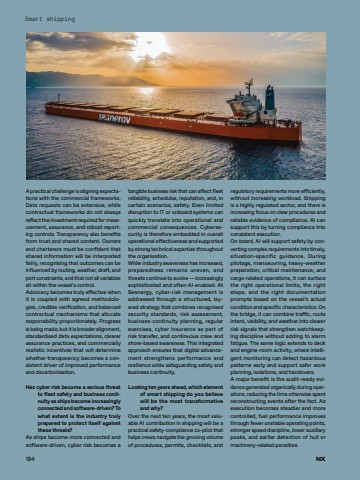
A practical challenge is aligning expectations with the commercial frameworks. Data requests can be extensive, while contractual frameworks do not always reflect the investment required for measurement, assurance, and robust reporting controls. Transparency also benefits from trust and shared content. Owners and charterers must be confident that shared information will be interpreted fairly, recognising that outcomes can be influenced by routing, weather, draft, and port constraints, and that not all variables sit within the vessel%u2019s control.Advocacy becomes truly effective when it is coupled with agreed methodologies, credible verification, and balanced contractual mechanisms that allocate responsibility proportionately. Progress is being made, but it is broader alignment, standardised data expectations, clearer assurance practices, and commercially realistic incentives that will determine whether transparency becomes a consistent driver of improved performance and decarbonisation.Has cyber risk become a serious threat to fleet safety and business continuity as ships become increasingly connected and software-driven? To what extent is the industry truly prepared to protect itself against these threats?As ships become more connected and software-driven, cyber risk becomes a tangible business risk that can affect fleet reliability, schedules, reputation, and, in certain scenarios, safety. Even limited disruption to IT or onboard systems can quickly translate into operational and commercial consequences. Cybersecurity is therefore embedded in overall operational effectiveness and supported by strong technical expertise throughout the organisation.While industry awareness has increased, preparedness remains uneven, and threats continue to evolve %u2014 increasingly sophisticated and often AI-enabled. At Seanergy, cyber-risk management is addressed through a structured, layered strategy that combines recognised security standards, risk assessment, business-continuity planning, regular exercises, cyber insurance as part of risk transfer, and continuous crew and shore-based awareness. This integrated approach ensures that digital advancement strengthens performance and resilience while safeguarding safety and business continuity.Looking ten years ahead, which element of smart shipping do you believe will be the most transformative and why?Over the next ten years, the most valuable AI contribution in shipping will be a practical safety-compliance co-pilot that helps crews navigate the growing volume of procedures, permits, checklists, and regulatory requirements more efficiently, without increasing workload. Shipping is a highly regulated sector, and there is increasing focus on clear procedures and reliable evidence of compliance. AI can support this by turning compliance into consistent execution.On board, AI will support safety by converting complex requirements into timely, situation-specific guidance. During pilotage, manoeuvring, heavy-weather preparation, critical maintenance, and cargo-related operations, it can surface the right operational limits, the right steps, and the right documentation prompts based on the vessel%u2019s actual condition and specific characteristics. On the bridge, it can combine traffic, route intent, visibility, and weather into clearer risk signals that strengthen watchkeeping discipline without adding to alarm fatigue. The same logic extends to deck and engine-room activity, where intelligent monitoring can detect hazardous patterns early and support safer work planning, isolations, and handovers.A major benefit is the audit-ready evidence generated organically during operations, reducing the time otherwise spent reconstructing events after the fact. As execution becomes steadier and more controlled, fuel performance improves through fewer unstable operating points, stronger speed discipline, lower auxiliary peaks, and earlier detection of hull or machinery-related penalties.Smart shipping184 NX


