


Page 37 - Demo
P. 37
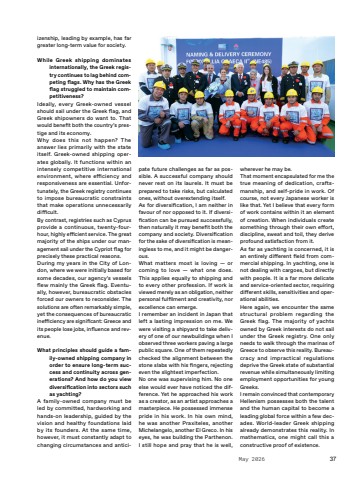
izenship, leading by example, has far greater long-term value for society.While Greek shipping dominates internationally, the Greek registry continues to lag behind competing flags. Why has the Greek flag struggled to maintain competitiveness?Ideally, every Greek-owned vessel should sail under the Greek flag, and Greek shipowners do want to. That would benefit both the country%u2019s prestige and its economy.Why does this not happen? The answer lies primarily with the state itself. Greek-owned shipping operates globally. It functions within an intensely competitive international environment, where efficiency and responsiveness are essential. Unfortunately, the Greek registry continues to impose bureaucratic constraints that make operations unnecessarily difficult.By contrast, registries such as Cyprus provide a continuous, twenty-fourhour, highly efficient service. The great majority of the ships under our management sail under the Cypriot flag for precisely these practical reasons.During my years in the City of London, where we were initially based for some decades, our agency%u2019s vessels flew mainly the Greek flag. Eventually, however, bureaucratic obstacles forced our owners to reconsider. The solutions are often remarkably simple, yet the consequences of bureaucratic inefficiency are significant: Greece and its people lose jobs, influence and revenue.What principles should guide a family-owned shipping company in order to ensure long-term success and continuity across generations? And how do you view diversification into sectors such as yachting?A family-owned company must be led by committed, hardworking and hands-on leadership, guided by the vision and healthy foundations laid by its founders. At the same time, however, it must constantly adapt to changing circumstances and anticipate future challenges as far as possible. A successful company should never rest on its laurels. It must be prepared to take risks, but calculated ones, without overextending itself.As for diversification, I am neither in favour of nor opposed to it. If diversification can be pursued successfully, then naturally it may benefit both the company and society. Diversification for the sake of diversification is meaningless to me, and it might be dangerous.What matters most is loving %u2014 or coming to love %u2014 what one does. This applies equally to shipping and to every other profession. If work is viewed merely as an obligation, neither personal fulfilment and creativity, nor excellence can emerge.I remember an incident in Japan that left a lasting impression on me. We were visiting a shipyard to take delivery of one of our newbuildings when I observed three workers paving a large public square. One of them repeatedly checked the alignment between the stone slabs with his fingers, rejecting even the slightest imperfection.No one was supervising him. No one else would ever have noticed the difference. Yet he approached his work as a creator, as an artist approaches a masterpiece. He possessed immense pride in his work. In his own mind, he was another Praxiteles, another Michelangelo, another El Greco. In his eyes, he was building the Parthenon. I still hope and pray that he is well, wherever he may be. That moment encapsulated for me the true meaning of dedication, craftsmanship, and self-pride in work. Of course, not every Japanese worker is like that. Yet I believe that every form of work contains within it an element of creation. When individuals create something through their own effort, discipline, sweat and toil, they derive profound satisfaction from it. As far as yachting is concerned, it is an entirely different field from commercial shipping. In yachting, one is not dealing with cargoes, but directly with people. It is a far more delicate and service-oriented sector, requiring different skills, sensitivities and operational abilities.Here again, we encounter the same structural problem regarding the Greek flag. The majority of yachts owned by Greek interests do not sail under the Greek registry. One only needs to walk through the marinas of Greece to observe this reality. Bureaucracy and impractical regulations deprive the Greek state of substantial revenue while simultaneously limiting employment opportunities for young Greeks.I remain convinced that contemporary Hellenism possesses both the talent and the human capital to become a leading global force within a few decades. World-leader Greek shipping already demonstrates this reality. In mathematics, one might call this a constructive proof of existence.May 2026 37


