


Page 34 - Demo
P. 34
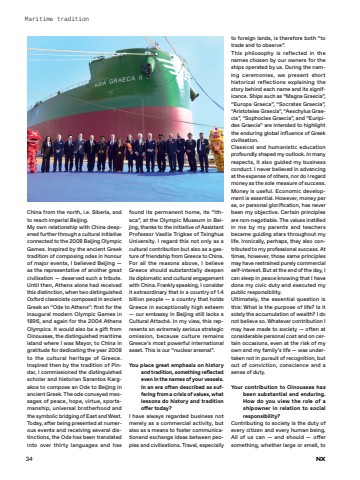
China from the north, i.e. Siberia, and to reach imperial Beijing.My own relationship with China deepened further through a cultural initiative connected to the 2008 Beijing Olympic Games. Inspired by the ancient Greek tradition of composing odes in honour of major events, I believed Beijing %u2014 as the representative of another great civilisation %u2014 deserved such a tribute. Until then, Athens alone had received this distinction, when two distinguished Oxford classicists composed in ancient Greek an %u201cOde to Athens%u201d: first for the inaugural modern Olympic Games in 1896, and again for the 2004 Athens Olympics. It would also be a gift from Oinousses, the distinguished maritime island where I was Mayor, to China in gratitude for dedicating the year 2008 to the cultural heritage of Greece. Inspired then by the tradition of Pindar, I commissioned the distinguished scholar and historian Sarantos Kargakos to compose an Ode to Beijing in ancient Greek. The ode conveyed messages of peace, hope, virtue, sportsmanship, universal brotherhood and the symbolic bridging of East and West.Today, after being presented at numerous events and receiving several distinctions, the Ode has been translated into over thirty languages and has found its permanent home, its %u201cIthaca%u201d, at the Olympic Museum in Beijing, thanks to the initiative of Assistant Professor Vasilis Trigkas of Tsinghua University. I regard this not only as a cultural contribution but also as a gesture of friendship from Greece to China.For all the reasons above, I believe Greece should substantially deepen its diplomatic and cultural engagement with China. Frankly speaking, I consider it extraordinary that in a country of 1.4 billion people %u2014 a country that holds Greece in exceptionally high esteem %u2014 our embassy in Beijing still lacks a Cultural Attach%u00e9. In my view, this represents an extremely serious strategic omission, because culture remains Greece%u2019s most powerful international asset. This is our %u201cnuclear arsenal%u201d.You place great emphasis on history and tradition, something reflected even in the names of your vessels. In an era often described as suffering from a crisis of values, what lessons do history and tradition offer today?I have always regarded business not merely as a commercial activity, but also as a means to foster communicationand exchange ideas between peoples and civilisations. Travel, especially to foreign lands, is therefore both %u201cto trade and to observe%u201d.This philosophy is reflected in the names chosen by our owners for the ships operated by us. During the naming ceremonies, we present short historical reflections explaining the story behind each name and its significance. Ships such as %u201cMagna Graecia%u201d, %u201cEuropa Graeca%u201d, %u201cSocrates Graecia%u201d, %u201cAristoteles Graecia%u201d, %u201cAeschylus Graecia%u201d, %u201cSophocles Graecia%u201d, and %u201cEuripides Graecia%u201d are intended to highlight the enduring global influence of Greek civilisation.Classical and humanistic education profoundly shaped my outlook. In many respects, it also guided my business conduct. I never believed in advancing at the expense of others, nor do I regard money as the sole measure of success.Money is useful. Economic development is essential. However, money per se, or personal glorification, has never been my objective. Certain principles are non-negotiable. The values instilled in me by my parents and teachers became guiding stars throughout my life. Ironically, perhaps, they also contributed to my professional success. At times, however, those same principles may have restrained purely commercial self-interest. But at the end of the day, I can sleep in peace knowing that I have done my civic duty and executed my public responsibility.Ultimately, the essential question is this: What is the purpose of life? Is it solely the accumulation of wealth? I do not believe so. Whatever contribution I may have made to society %u2014 often at considerable personal cost and on certain occasions, even at the risk of my own and my family%u2019s life %u2014 was undertaken not in pursuit of recognition, but out of conviction, conscience and a sense of duty.Your contribution to Oinousses has been substantial and enduring. How do you view the role of a shipowner in relation to social responsibility?Contributing to society is the duty of every citizen and every human being. All of us can %u2014 and should %u2014 offer something, whether large or small, to Maritime tradition34 NX


