


Page 318 - Demo
P. 318
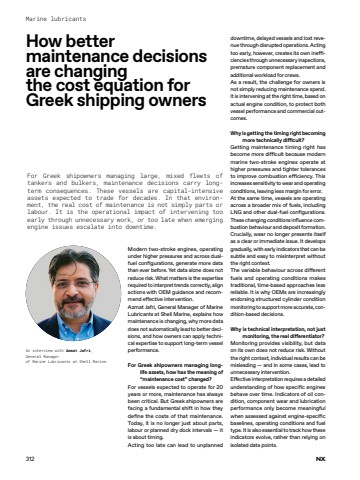
How better maintenance decisions are changingthe cost equation for Greek shipping ownersModern two-stroke engines, operating under higher pressures and across dualfuel configurations, generate more data than ever before. Yet data alone does not reduce risk. What matters is the expertise required to interpret trends correctly, align actions with OEM guidance and recommend effective intervention.Azmat Jafri, General Manager of Marine Lubricants at Shell Marine, explains how maintenance is changing, why more data does not automatically lead to better decisions, and how owners can apply technical expertise to support long-term vessel performance.For Greek shipowners managing longlife assets, how has the meaning of %u201cmaintenance cost%u201d changed?For vessels expected to operate for 20 years or more, maintenance has always been critical. But Greek shipowners are facing a fundamental shift in how they define the costs of that maintenance. Today, it is no longer just about parts, labour or planned dry dock intervals %u2014 it is about timing.Acting too late can lead to unplanned downtime, delayed vessels and lost revenue through disrupted operations. Acting too early, however, creates its own inefficiencies through unnecessary inspections, premature component replacement and additional workload for crews.As a result, the challenge for owners is not simply reducing maintenance spend. It is intervening at the right time, based on actual engine condition, to protect both vessel performance and commercial outcomes.Why is getting the timing right becoming more technically difficult?Getting maintenance timing right has become more difficult because modern marine two-stroke engines operate at higher pressures and tighter tolerances to improve combustion efficiency. This increases sensitivity to wear and operating conditions, leaving less margin for error. At the same time, vessels are operating across a broader mix of fuels, including LNG and other dual-fuel configurations. These changing conditions influence combustion behaviour and deposit formation. Crucially, wear no longer presents itself as a clear or immediate issue. It develops gradually, with early indicators that can be subtle and easy to misinterpret without the right context.The variable behaviour across different fuels and operating conditions makes traditional, time-based approaches less reliable. It is why OEMs are increasingly endorsing structured cylinder condition monitoring to support more accurate, condition-based decisions.Why is technical interpretation, not just monitoring, the real differentiator?Monitoring provides visibility, but data on its own does not reduce risk. Without the right context, individual results can be misleading %u2014 and in some cases, lead to unnecessary intervention.Effective interpretation requires a detailed understanding of how specific engines behave over time. Indicators of oil condition, component wear and lubrication performance only become meaningful when assessed against engine-specific baselines, operating conditions and fuel type. It is also essential to track how these indicators evolve, rather than relying on isolated data points.For Greek shipowners managing large, mixed fleets of tankers and bulkers, maintenance decisions carry longterm consequences. These vessels are capital-intensive assets expected to trade for decades. In that environment, the real cost of maintenance is not simply parts or labour. It is the operational impact of intervening too early through unnecessary work, or too late when emerging engine issues escalate into downtime.An interview with Azmat Jafri,General Manager of Marine Lubricants at Shell MarineMarine lubricants312 NX


