


Page 313 - Demo
P. 313
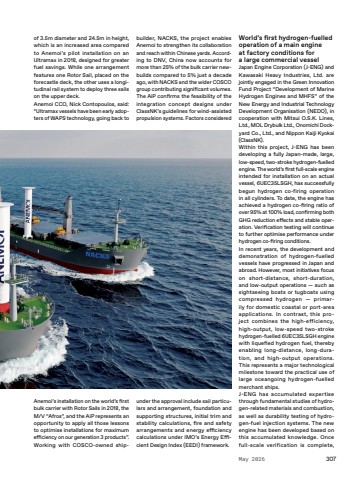
Credit: Anemoiof 3.5m diameter and 24.5m in height, which is an increased area compared to Anemoi%u2019s pilot installation on an Ultramax in 2018, designed for greater fuel savings. While one arrangement features one Rotor Sail, placed on the forecastle deck, the other uses a longitudinal rail system to deploy three sails on the upper deck.Anemoi CCO, Nick Contopoulos, said: %u201cUltramax vessels have been early adopters of WAPS technology, going back to Anemoi%u2019s installation on the world%u2019s first bulk carrier with Rotor Sails in 2018, the M/V %u201cAfros%u201d, and the AiP represents an opportunity to apply all those lessons to optimise installations for maximum efficiency on our generation 3 products%u201d.Working with COSCO-owned shipbuilder, NACKS, the project enables Anemoi to strengthen its collaboration and reach within Chinese yards. According to DNV, China now accounts for more than 25% of the bulk carrier newbuilds compared to 5% just a decade ago, with NACKS and the wider COSCO group contributing significant volumes.The AiP confirms the feasibility of the integration concept designs under ClassNK%u2019s guidelines for wind-assisted propulsion systems. Factors considered under the approval include sail particulars and arrangement, foundation and supporting structures, initial trim and stability calculations, fire and safety arrangements and energy efficiency calculations under IMO%u2019s Energy Efficient Design Index (EEDI) framework.World%u2019s first hydrogen-fuelled operation of a main engine at factory conditions for a large commercial vesselJapan Engine Corporation (J-ENG) and Kawasaki Heavy Industries, Ltd. are jointly engaged in the Green Innovation Fund Project %u201cDevelopment of Marine Hydrogen Engines and MHFS%u201d of the New Energy and Industrial Technology Development Organisation (NEDO), in cooperation with Mitsui O.S.K. Lines, Ltd., MOL Drybulk Ltd., Onomichi Dockyard Co., Ltd., and Nippon Kaiji Kyokai (ClassNK). Within this project, J-ENG has been developing a fully Japan-made, large, low-speed, two-stroke hydrogen-fuelled engine. The world%u2019s first full-scale engine intended for installation on an actual vessel, 6UEC35LSGH, has successfully begun hydrogen co-firing operation in all cylinders. To date, the engine has achieved a hydrogen co-firing ratio of over 95% at 100% load, confirming both GHG reduction effects and stable operation. Verification testing will continue to further optimise performance under hydrogen co-firing conditions. In recent years, the development and demonstration of hydrogen-fuelled vessels have progressed in Japan and abroad. However, most initiatives focus on short-distance, short-duration, and low-output operations %u2014 such as sightseeing boats or tugboats using compressed hydrogen %u2014 primarily for domestic coastal or port-area applications. In contrast, this project combines the high-efficiency, high-output, low-speed two-stroke hydrogen-fuelled 6UEC35LSGH engine with liquefied hydrogen fuel, thereby enabling long-distance, long-duration, and high-output operations. This represents a major technological milestone toward the practical use of large oceangoing hydrogen-fuelled merchant ships. J-ENG has accumulated expertise through fundamental studies of hydrogen-related materials and combustion, as well as durability testing of hydrogen-fuel injection systems. The new engine has been developed based on this accumulated knowledge. Once full-scale verification is complete, May 2026 307


