


Page 294 - Demo
P. 294
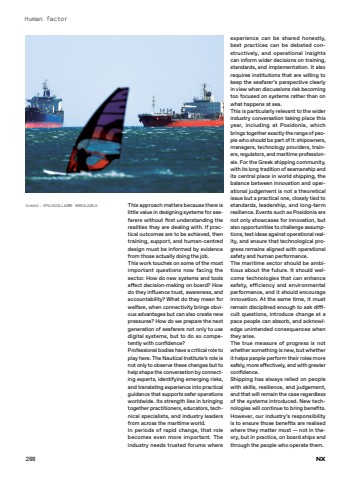
This approach matters because there is little value in designing systems for seafarers without first understanding the realities they are dealing with. If practical outcomes are to be achieved, then training, support, and human-centred design must be informed by evidence from those actually doing the job.This work touches on some of the most important questions now facing the sector. How do new systems and tools affect decision-making on board? How do they influence trust, awareness, and accountability? What do they mean for welfare, when connectivity brings obvious advantages but can also create new pressures? How do we prepare the next generation of seafarers not only to use digital systems, but to do so competently with confidence?Professional bodies have a critical role to play here. The Nautical Institute%u2019s role is not only to observe these changes but to help shape the conversation by connecting experts, identifying emerging risks, and translating experience into practical guidance that supports safer operations worldwide. Its strength lies in bringing together practitioners, educators, technical specialists, and industry leaders from across the maritime world. In periods of rapid change, that role becomes even more important. The industry needs trusted forums where experience can be shared honestly, best practices can be debated constructively, and operational insights can inform wider decisions on training, standards, and implementation. It also requires institutions that are willing to keep the seafarer%u2019s perspective clearly in view when discussions risk becoming too focused on systems rather than on what happens at sea. This is particularly relevant to the wider industry conversation taking place this year, including at Posidonia, which brings together exactly the range of people who should be part of it: shipowners, managers, technology providers, trainers, regulators, and maritime professionals. For the Greek shipping community, with its long tradition of seamanship and its central place in world shipping, the balance between innovation and operational judgement is not a theoretical issue but a practical one, closely tied to standards, leadership, and long-term resilience. Events such as Posidonia are not only showcases for innovation, but also opportunities to challenge assumptions, test ideas against operational reality, and ensure that technological progress remains aligned with operational safety and human performance. The maritime sector should be ambitious about the future. It should welcome technologies that can enhance safety, efficiency and environmental performance, and it should encourage innovation. At the same time, it must remain disciplined enough to ask difficult questions, introduce change at a pace people can absorb, and acknowledge unintended consequences when they arise. The true measure of progress is not whether something is new, but whether it helps people perform their roles more safely, more effectively, and with greater confidence.Shipping has always relied on people with skills, resilience, and judgement, and that will remain the case regardless of the systems introduced. New technologies will continue to bring benefits. However, our industry%u2019s responsibility is to ensure those benefits are realised where they matter most %u2014 not in theory, but in practice, on board ships and through the people who operate them.Human factorCredit: EPA/GUILLAUME HORCAJUELO288 NX


