


Page 287 - Demo
P. 287
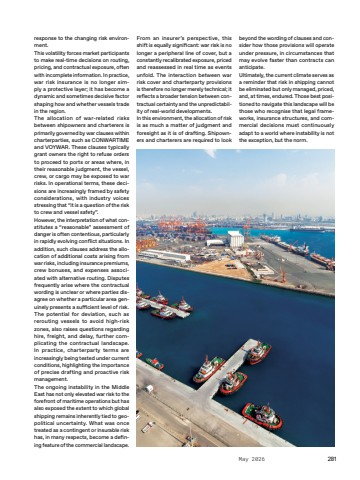
response to the changing risk environment. This volatility forces market participants to make real-time decisions on routing, pricing, and contractual exposure, often with incomplete information. In practice, war risk insurance is no longer simply a protective layer; it has become a dynamic and sometimes decisive factor shaping how and whether vessels trade in the region.The allocation of war-related risks between shipowners and charterers is primarily governed by war clauses within charterparties, such as CONWARTIME and VOYWAR. These clauses typically grant owners the right to refuse orders to proceed to ports or areas where, in their reasonable judgment, the vessel, crew, or cargo may be exposed to war risks. In operational terms, these decisions are increasingly framed by safety considerations, with industry voices stressing that %u201cit is a question of the risk to crew and vessel safety%u201d. However, the interpretation of what constitutes a %u201creasonable%u201d assessment of danger is often contentious, particularly in rapidly evolving conflict situations. In addition, such clauses address the allocation of additional costs arising from war risks, including insurance premiums, crew bonuses, and expenses associated with alternative routing. Disputes frequently arise where the contractual wording is unclear or where parties disagree on whether a particular area genuinely presents a sufficient level of risk. The potential for deviation, such as rerouting vessels to avoid high-risk zones, also raises questions regarding hire, freight, and delay, further complicating the contractual landscape. In practice, charterparty terms are increasingly being tested under current conditions, highlighting the importance of precise drafting and proactive risk management.The ongoing instability in the Middle East has not only elevated war risk to the forefront of maritime operations but has also exposed the extent to which global shipping remains inherently tied to geopolitical uncertainty. What was once treated as a contingent or insurable risk has, in many respects, become a defining feature of the commercial landscape. From an insurer%u2019s perspective, this shift is equally significant: war risk is no longer a peripheral line of cover, but a constantly recalibrated exposure, priced and reassessed in real time as events unfold. The interaction between war risk cover and charterparty provisions is therefore no longer merely technical; it reflects a broader tension between contractual certainty and the unpredictability of real-world developments. In this environment, the allocation of risk is as much a matter of judgment and foresight as it is of drafting. Shipowners and charterers are required to look beyond the wording of clauses and consider how those provisions will operate under pressure, in circumstances that may evolve faster than contracts can anticipate. Ultimately, the current climate serves as a reminder that risk in shipping cannot be eliminated but only managed, priced, and, at times, endured. Those best positioned to navigate this landscape will be those who recognise that legal frameworks, insurance structures, and commercial decisions must continuously adapt to a world where instability is not the exception, but the norm.May 2026 281


