


Page 254 - Demo
P. 254
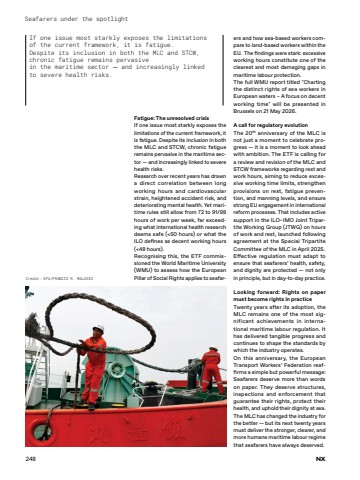
Fatigue: The unresolved crisisIf one issue most starkly exposes the limitations of the current framework, it is fatigue. Despite its inclusion in both the MLC and STCW, chronic fatigue remains pervasive in the maritime sector %u2014 and increasingly linked to severe health risks.Research over recent years has drawn a direct correlation between long working hours and cardiovascular strain, heightened accident risk, and deteriorating mental health. Yet maritime rules still allow from 72 to 91/98 hours of work per week, far exceeding what international health research deems safe (<50 hours) or what the ILO defines as decent working hours (<48 hours).Recognising this, the ETF commissioned the World Maritime University (WMU) to assess how the European Pillar of Social Rights applies to seafarers and how sea-based workers compare to land-based workers within the EU. The findings were stark: excessive working hours constitute one of the clearest and most damaging gaps in maritime labour protection.The full WMU report titled \the distinct rights of sea workers in European waters %u2013 A focus on decent working time\Brussels on 21 May 2026.A call for regulatory evolutionThe 20th anniversary of the MLC is not just a moment to celebrate progress %u2014 it is a moment to look ahead with ambition. The ETF is calling for a review and revision of the MLC and STCW frameworks regarding rest and work hours, aiming to reduce excessive working time limits, strengthen provisions on rest, fatigue prevention, and manning levels, and ensure strong EU engagement in international reform processes. That includes active support in the ILO%u2013IMO Joint Tripartite Working Group (JTWG) on hours of work and rest, launched following agreement at the Special Tripartite Committee of the MLC in April 2025.Effective regulation must adapt to ensure that seafarers%u2019 health, safety, and dignity are protected %u2014 not only in principle, but in day-to-day practice.Looking forward: Rights on paper must become rights in practiceTwenty years after its adoption, the MLC remains one of the most significant achievements in international maritime labour regulation. It has delivered tangible progress and continues to shape the standards by which the industry operates.On this anniversary, the European Transport Workers%u2019 Federation reaffirms a simple but powerful message: Seafarers deserve more than words on paper. They deserve structures, inspections and enforcement that guarantee their rights, protect their health, and uphold their dignity at sea.The MLC has changed the industry for the better %u2014 but its next twenty years must deliver the stronger, clearer, and more humane maritime labour regime that seafarers have always deserved.If one issue most starkly exposes the limitations of the current framework, it is fatigue. Despite its inclusion in both the MLC and STCW, chronic fatigue remains pervasive in the maritime sector %u2014 and increasingly linked to severe health risks.Seafarers under the spotlightCredit: EPA/FRANCIS R. MALASIG248 NX


