


Page 249 - Demo
P. 249
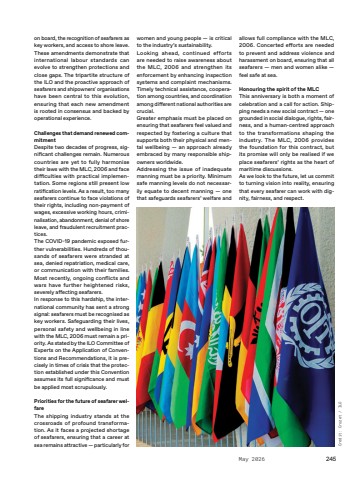
on board, the recognition of seafarers as key workers, and access to shore leave.These amendments demonstrate that international labour standards can evolve to strengthen protections and close gaps. The tripartite structure of the ILO and the proactive approach of seafarers and shipowners' organisations have been central to this evolution, ensuring that each new amendment is rooted in consensus and backed by operational experience.Challenges that demand renewed commitmentDespite two decades of progress, significant challenges remain. Numerous countries are yet to fully harmonise their laws with the MLC, 2006 and face difficulties with practical implementation. Some regions still present low ratification levels. As a result, too many seafarers continue to face violations of their rights, including non-payment of wages, excessive working hours, criminalisation, abandonment, denial of shore leave, and fraudulent recruitment practices. The COVID-19 pandemic exposed further vulnerabilities. Hundreds of thousands of seafarers were stranded at sea, denied repatriation, medical care, or communication with their families. Most recently, ongoing conflicts and wars have further heightened risks, severely affecting seafarers. In response to this hardship, the international community has sent a strong signal: seafarers must be recognised as key workers. Safeguarding their lives, personal safety and wellbeing in line with the MLC, 2006 must remain a priority. As stated by the ILO Committee of Experts on the Application of Conventions and Recommendations, it is precisely in times of crisis that the protection established under this Convention assumes its full significance and must be applied most scrupulously.Priorities for the future of seafarer welfareThe shipping industry stands at the crossroads of profound transformation. As it faces a projected shortage of seafarers, ensuring that a career at sea remains attractive %u2014 particularly for women and young people %u2014 is critical to the industry%u2019s sustainability.Looking ahead, continued efforts are needed to raise awareness about the MLC, 2006 and strengthen its enforcement by enhancing inspection systems and complaint mechanisms. Timely technical assistance, cooperation among countries, and coordination among different national authorities are crucial.Greater emphasis must be placed on ensuring that seafarers feel valued and respected by fostering a culture that supports both their physical and mental wellbeing %u2014 an approach already embraced by many responsible shipowners worldwide.Addressing the issue of inadequate manning must be a priority. Minimum safe manning levels do not necessarily equate to decent manning %u2014 one that safeguards seafarers%u2019 welfare and allows full compliance with the MLC, 2006. Concerted efforts are needed to prevent and address violence and harassment on board, ensuring that all seafarers %u2014 men and women alike %u2014 feel safe at sea. Honouring the spirit of the MLCThis anniversary is both a moment of celebration and a call for action. Shipping needs a new social contract %u2014 one grounded in social dialogue, rights, fairness, and a human-centred approach to the transformations shaping the industry. The MLC, 2006 provides the foundation for this contract, but its promise will only be realised if we place seafarers%u2019 rights as the heart of maritime discussions.As we look to the future, let us commit to turning vision into reality, ensuring that every seafarer can work with dignity, fairness, and respect.Credit: Crozet / ILOMay 2026 245


