


Page 247 - Demo
P. 247
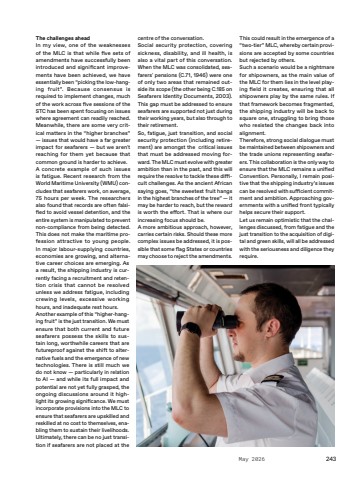
The challenges aheadIn my view, one of the weaknesses of the MLC is that while five sets of amendments have successfully been introduced and significant improvements have been achieved, we have essentially been %u201cpicking the low-hanging fruit%u201d. Because consensus is required to implement changes, much of the work across five sessions of the STC has been spent focusing on issues where agreement can readily reached. Meanwhile, there are some very critical matters in the %u201chigher branches%u201d %u2014 issues that would have a far greater impact for seafarers %u2014 but we aren't reaching for them yet because that common ground is harder to achieve.A concrete example of such issues is fatigue. Recent research from the World Maritime University (WMU) concludes that seafarers work, on average, 75 hours per week. The researchers also found that records are often falsified to avoid vessel detention, and the entire system is manipulated to prevent non-compliance from being detected. This does not make the maritime profession attractive to young people. In major labour-supplying countries, economies are growing, and alternative career choices are emerging. As a result, the shipping industry is currently facing a recruitment and retention crisis that cannot be resolved unless we address fatigue, including crewing levels, excessive working hours, and inadequate rest hours.Another example of this %u201chigher-hanging fruit%u201d is the just transition. We must ensure that both current and future seafarers possess the skills to sustain long, worthwhile careers that are futureproof against the shift to alternative fuels and the emergence of new technologies. There is still much we do not know %u2014 particularly in relation to AI %u2014 and while its full impact and potential are not yet fully grasped, the ongoing discussions around it highlight its growing significance. We must incorporate provisions into the MLC to ensure that seafarers are upskilled and reskilled at no cost to themselves, enabling them to sustain their livelihoods. Ultimately, there can be no just transition if seafarers are not placed at the centre of the conversation.Social security protection, covering sickness, disability, and ill health, is also a vital part of this conversation. When the MLC was consolidated, seafarers' pensions (C.71, 1946) were one of only two areas that remained outside its scope (the other being C.185 on Seafarers Identity Documents, 2003). This gap must be addressed to ensure seafarers are supported not just during their working years, but also through to their retirement.So, fatigue, just transition, and social security protection (including retirement) are amongst the critical issues that must be addressed moving forward. The MLC must evolve with greater ambition than in the past, and this will require the resolve to tackle these difficult challenges. As the ancient African saying goes, %u201cthe sweetest fruit hangs in the highest branches of the tree%u201d %u2014 it may be harder to reach, but the reward is worth the effort. That is where our increasing focus should be.A more ambitious approach, however, carries certain risks. Should these more complex issues be addressed, it is possible that some flag States or countries may choose to reject the amendments. This could result in the emergence of a %u201ctwo-tier%u201d MLC, whereby certain provisions are accepted by some countries but rejected by others. Such a scenario would be a nightmare for shipowners, as the main value of the MLC for them lies in the level playing field it creates, ensuring that all shipowners play by the same rules. If that framework becomes fragmented, the shipping industry will be back to square one, struggling to bring those who resisted the changes back into alignment. Therefore, strong social dialogue must be maintained between shipowners and the trade unions representing seafarers. This collaboration is the only way to ensure that the MLC remains a unified Convention. Personally, I remain positive that the shipping industry%u2019s issues can be resolved with sufficient commitment and ambition. Approaching governments with a unified front typically helps secure their support. Let us remain optimistic that the challenges discussed, from fatigue and the just transition to the acquisition of digital and green skills, will all be addressed with the seriousness and diligence they require.May 2026 243


