


Page 248 - Demo
P. 248
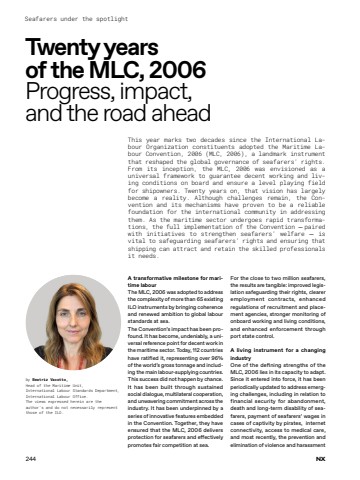
Twenty years of the MLC, 2006Progress, impact, and the road aheadby Beatriz Vacotto, Head of the Maritime Unit, International Labour Standards Department, International Labour Office. The views expressed herein are the author%u2019s and do not necessarily represent those of the ILO.This year marks two decades since the International Labour Organization constituents adopted the Maritime Labour Convention, 2006 (MLC, 2006), a landmark instrument that reshaped the global governance of seafarers%u2019 rights. From its inception, the MLC, 2006 was envisioned as a universal framework to guarantee decent working and living conditions on board and ensure a level playing field for shipowners. Twenty years on, that vision has largely become a reality. Although challenges remain, the Convention and its mechanisms have proven to be a reliable foundation for the international community in addressing them. As the maritime sector undergoes rapid transformations, the full implementation of the Convention %u2014 paired with initiatives to strengthen seafarers%u2019 welfare %u2014 is vital to safeguarding seafarers%u2019 rights and ensuring that shipping can attract and retain the skilled professionals it needs.Seafarers under the spotlightA transformative milestone for maritime labourThe MLC, 2006 was adopted to address the complexity of more than 65 existing ILO instruments by bringing coherence and renewed ambition to global labour standards at sea.The Convention%u2019s impact has been profound. It has become, undeniably, a universal reference point for decent work in the maritime sector. Today, 112 countries have ratified it, representing over 96% of the world%u2019s gross tonnage and including the main labour-supplying countries.This success did not happen by chance. It has been built through sustained social dialogue, multilateral cooperation, and unwavering commitment across the industry. It has been underpinned by a series of innovative features embedded in the Convention. Together, they have ensured that the MLC, 2006 delivers protection for seafarers and effectively promotes fair competition at sea.For the close to two million seafarers, the results are tangible: improved legislation safeguarding their rights, clearer employment contracts, enhanced regulations of recruitment and placement agencies, stronger monitoring of onboard working and living conditions, and enhanced enforcement through port state control. A living instrument for a changing industryOne of the defining strengths of the MLC, 2006 lies in its capacity to adapt. Since it entered into force, it has been periodically updated to address emerging challenges, including in relation to financial security for abandonment, death and long-term disability of seafarers, payment of seafarers%u2019 wages in cases of captivity by pirates, internet connectivity, access to medical care, and most recently, the prevention and elimination of violence and harassment 244 NX


