


Page 110 - Demo
P. 110
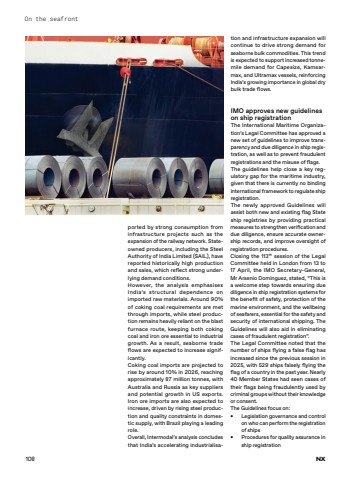
ported by strong consumption from infrastructure projects such as the expansion of the railway network. Stateowned producers, including the Steel Authority of India Limited (SAIL), have reported historically high production and sales, which reflect strong underlying demand conditions.However, the analysis emphasises India%u2019s structural dependence on imported raw materials. Around 90% of coking coal requirements are met through imports, while steel production remains heavily reliant on the blast furnace route, keeping both coking coal and iron ore essential to industrial growth. As a result, seaborne trade flows are expected to increase significantly.Coking coal imports are projected to rise by around 10% in 2026, reaching approximately 87 million tonnes, with Australia and Russia as key suppliers and potential growth in US exports. Iron ore imports are also expected to increase, driven by rising steel production and quality constraints in domestic supply, with Brazil playing a leading role.Overall, Intermodal%u2019s analysis concludes that India%u2019s accelerating industrialisation and infrastructure expansion will continue to drive strong demand for seaborne bulk commodities. This trend is expected to support increased tonnemile demand for Capesize, Kamsarmax, and Ultramax vessels, reinforcing India%u2019s growing importance in global dry bulk trade flows.IMO approves new guidelines on ship registrationThe International Maritime Organization%u2019s Legal Committee has approved a new set of guidelines to improve transparency and due diligence in ship registration, as well as to prevent fraudulent registrations and the misuse of flags. The guidelines help close a key regulatory gap for the maritime industry, given that there is currently no binding international framework to regulate ship registration. The newly approved Guidelines will assist both new and existing flag State ship registries by providing practical measures to strengthen verification and due diligence, ensure accurate ownership records, and improve oversight of registration procedures.Closing the 113th session of the Legal Committee held in London from 13 to 17 April, the IMO Secretary-General, Mr Arsenio Dominguez, stated, %u201cThis is a welcome step towards ensuring due diligence in ship registration systems for the benefit of safety, protection of the marine environment, and the wellbeing of seafarers, essential for the safety and security of international shipping. The Guidelines will also aid in eliminating cases of fraudulent registration%u201d. The Legal Committee noted that the number of ships flying a false flag has increased since the previous session in 2025, with 529 ships falsely flying the flag of a country in the past year. Nearly 40 Member States had seen cases of their flags being fraudulently used by criminal groups without their knowledge or consent. The Guidelines focus on: %u2022 Legislation governance and control on who can perform the registration of ships %u2022 Procedures for quality assurance in ship registration On the seafront108 NX


