


Page 305 - Demo
P. 305
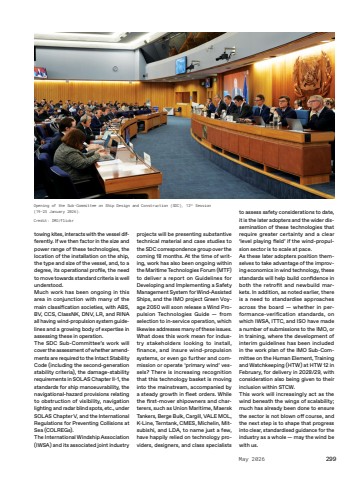
towing kites, interacts with the vessel differently. If we then factor in the size and power range of these technologies, the location of the installation on the ship, the type and size of the vessel, and, to a degree, its operational profile, the need to move towards standard criteria is well understood.Much work has been ongoing in this area in conjunction with many of the main classification societies, with ABS, BV, CCS, ClassNK, DNV, LR, and RINA all having wind-propulsion system guidelines and a growing body of expertise in assessing these in operation.The SDC Sub-Committee%u2019s work will cover the assessment of whether amendments are required to the Intact Stability Code (including the second-generation stability criteria), the damage-stability requirements in SOLAS Chapter II-1, the standards for ship manoeuvrability, the navigational-hazard provisions relating to obstruction of visibility, navigation lighting and radar blind spots, etc., under SOLAS Chapter V, and the International Regulations for Preventing Collisions at Sea (COLREGs).The International Windship Association (IWSA) and its associated joint industry projects will be presenting substantive technical material and case studies to the SDC correspondence group over the coming 18 months. At the time of writing, work has also been ongoing within the Maritime Technologies Forum (MTF) to deliver a report on Guidelines for Developing and Implementing a Safety Management System for Wind-Assisted Ships, and the IMO project Green Voyage 2050 will soon release a Wind Propulsion Technologies Guide %u2014 from selection to in-service operation, which likewise addresses many of these issues.What does this work mean for industry stakeholders looking to install, finance, and insure wind-propulsion systems, or even go further and commission or operate %u2018primary wind%u2019 vessels? There is increasing recognition that this technology basket is moving into the mainstream, accompanied by a steady growth in fleet orders. While the first-mover shipowners and charterers, such as Union Maritime, Maersk Tankers, Berge Bulk, Cargill, VALE MOL, K-Line, Terntank, CMES, Michelin, Mitsubishi, and LDA, to name just a few, have happily relied on technology providers, designers, and class specialists to assess safety considerations to date, it is the later adopters and the wider dissemination of these technologies that require greater certainty and a clear %u2018level playing field%u2019 if the wind-propulsion sector is to scale at pace.As these later adopters position themselves to take advantage of the improving economics in wind technology, these standards will help build confidence in both the retrofit and newbuild markets. In addition, as noted earlier, there is a need to standardise approaches across the board %u2014 whether in performance-verification standards, on which IWSA, ITTC, and ISO have made a number of submissions to the IMO, or in training, where the development of interim guidelines has been included in the work plan of the IMO Sub-Committee on the Human Element, Training and Watchkeeping (HTW) at HTW 12 in February, for delivery in 2028/29, with consideration also being given to their inclusion within STCW.This work will increasingly act as the wind beneath the wings of scalability; much has already been done to ensure the sector is not blown off course, and the next step is to shape that progress into clear, standardised guidance for the industry as a whole %u2014 may the wind be with us.Opening of the Sub-Committee on Ship Design and Construction (SDC), 12th Session (19-23 January 2026).Credit: %u0399%u039c%u039f/flickrMay 2026 299


