


Page 234 - Demo
P. 234
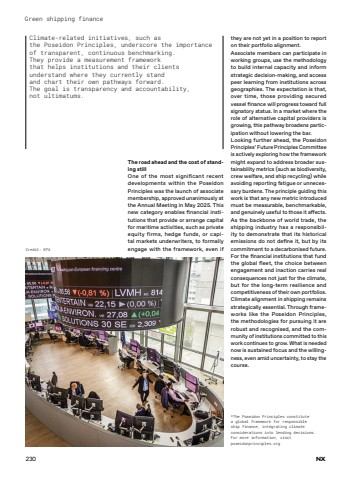
Green shipping financeThe road ahead and the cost of standing still One of the most significant recent developments within the Poseidon Principles was the launch of associate membership, approved unanimously at the Annual Meeting in May 2025. This new category enables financial institutions that provide or arrange capital for maritime activities, such as private equity firms, hedge funds, or capital markets underwriters, to formally engage with the framework, even if they are not yet in a position to report on their portfolio alignment. Associate members can participate in working groups, use the methodology to build internal capacity and inform strategic decision-making, and access peer learning from institutions across geographies. The expectation is that, over time, those providing secured vessel finance will progress toward full signatory status. In a market where the role of alternative capital providers is growing, this pathway broadens participation without lowering the bar. Looking further ahead, the Poseidon Principles%u2019 Future Principles Committee is actively exploring how the framework might expand to address broader sustainability metrics (such as biodiversity, crew welfare, and ship recycling) while avoiding reporting fatigue or unnecessary burdens. The principle guiding this work is that any new metric introduced must be measurable, benchmarkable, and genuinely useful to those it affects. As the backbone of world trade, the shipping industry has a responsibility to demonstrate that its historical emissions do not define it, but by its commitment to a decarbonised future. For the financial institutions that fund the global fleet, the choice between engagement and inaction carries real consequences not just for the climate, but for the long-term resilience and competitiveness of their own portfolios. Climate alignment in shipping remains strategically essential. Through frameworks like the Poseidon Principles, the methodologies for pursuing it are robust and recognised, and the community of institutions committed to this work continues to grow. What is needed now is sustained focus and the willingness, even amid uncertainty, to stay the course. *The Poseidon Principles constitute a global framework for responsible ship finance, integrating climate considerations into lending decisions. For more information, visit poseidonprinciples.org. Climate-related initiatives, such as the Poseidon Principles, underscore the importance of transparent, continuous benchmarking. They provide a measurement frameworkthat helps institutions and their clients understand where they currently stand and chart their own pathways forward. The goal is transparency and accountability, not ultimatums. Credit: EPA230 NX


