


Page 166 - Demo
P. 166
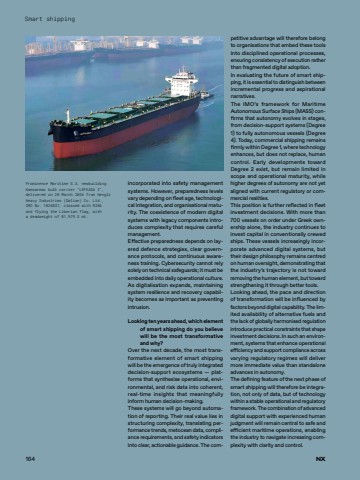
incorporated into safety management systems. However, preparedness levels vary depending on fleet age, technological integration, and organisational maturity. The coexistence of modern digital systems with legacy components introduces complexity that requires careful management.Effective preparedness depends on layered defence strategies, clear governance protocols, and continuous awareness training. Cybersecurity cannot rely solely on technical safeguards; it must be embedded into daily operational culture. As digitalisation expands, maintaining system resilience and recovery capability becomes as important as preventing intrusion. Looking ten years ahead, which element of smart shipping do you believe will be the most transformative and why?Over the next decade, the most transformative element of smart shipping will be the emergence of truly integrated decision-support ecosystems %u2014 platforms that synthesise operational, environmental, and risk data into coherent, real-time insights that meaningfully inform human decision-making.These systems will go beyond automation of reporting. Their real value lies in structuring complexity, translating performance trends, metocean data, compliance requirements, and safety indicators into clear, actionable guidance. The competitive advantage will therefore belong to organisations that embed these tools into disciplined operational processes, ensuring consistency of execution rather than fragmented digital adoption.In evaluating the future of smart shipping, it is essential to distinguish between incremental progress and aspirational narratives.The IMO%u2019s framework for Maritime Autonomous Surface Ships (MASS) confirms that autonomy evolves in stages, from decision-support systems (Degree 1) to fully autonomous vessels (Degree 4). Today, commercial shipping remains firmly within Degree 1, where technology enhances, but does not replace, human control. Early developments toward Degree 2 exist, but remain limited in scope and operational maturity, while higher degrees of autonomy are not yet aligned with current regulatory or commercial realities.This position is further reflected in fleet investment decisions. With more than 700 vessels on order under Greek ownership alone, the industry continues to invest capital in conventionally crewed ships. These vessels increasingly incorporate advanced digital systems, but their design philosophy remains centred on human oversight, demonstrating that the industry%u2019s trajectory is not toward removing the human element, but toward strengthening it through better tools.Looking ahead, the pace and direction of transformation will be influenced by factors beyond digital capability. The limited availability of alternative fuels and the lack of globally harmonised regulation introduce practical constraints that shape investment decisions. In such an environment, systems that enhance operational efficiency and support compliance across varying regulatory regimes will deliver more immediate value than standalone advances in autonomy.The defining feature of the next phase of smart shipping will therefore be integration, not only of data, but of technology within a stable operational and regulatory framework. The combination of advanced digital support with experienced human judgment will remain central to safe and efficient maritime operations, enabling the industry to navigate increasing complexity with clarity and control.Smart shippingProminence Maritime S.A. newbuilding Kamsarmax bulk carrier %u201cLEFKADA I%u201d, delivered on 20 March 2026 from Hengli Heavy Industries (Dalian) Co. Ltd., IMO No. 1026037, classed with RINAand flying the Liberian flag, with a deadweight of 81,979.3 mt.164 NX


