


Page 128 - Demo
P. 128
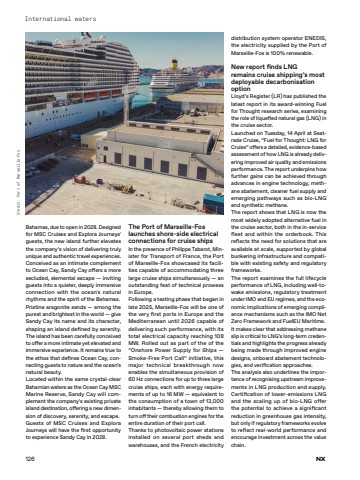
Bahamas, due to open in 2028. Designed for MSC Cruises and Explora Journeys' guests, the new island further elevates the company%u2019s vision of delivering truly unique and authentic travel experiences.Conceived as an intimate complement to Ocean Cay, Sandy Cay offers a more secluded, elemental escape %u2014 inviting guests into a quieter, deeply immersive connection with the ocean's natural rhythms and the spirit of the Bahamas.Pristine aragonite sands %u2014 among the purest and brightest in the world %u2014 give Sandy Cay its name and its character, shaping an island defined by serenity. The island has been carefully conceived to offer a more intimate yet elevated and immersive experience. It remains true to the ethos that defines Ocean Cay, connecting guests to nature and the ocean%u2019s natural beauty.Located within the same crystal-clear Bahamian waters as the Ocean Cay MSC Marine Reserve, Sandy Cay will complement the company%u2019s existing private island destination, offering a new dimension of discovery, serenity, and escape.Guests of MSC Cruises and Explora Journeys will have the first opportunity to experience Sandy Cay in 2028.The Port of Marseille-Fos launches shore-side electrical connections for cruise shipsIn the presence of Philippe Tabarot, Minister for Transport of France, the Port of Marseille-Fos showcased its facilities capable of accommodating three large cruise ships simultaneously %u2014 an outstanding feat of technical prowess in Europe. Following a testing phase that began in late 2025, Marseille-Fos will be one of the very first ports in Europe and the Mediterranean until 2026 capable of delivering such performance, with its total electrical capacity reaching 108 MW. Rolled out as part of the of the %u201cOnshore Power Supply for Ships %u2014 Smoke-Free Port Call%u201d initiative, this major technical breakthrough now enables the simultaneous provision of 60 Hz connections for up to three large cruise ships, each with energy requirements of up to 16 MW %u2014 equivalent to the consumption of a town of 13,000 inhabitants %u2014 thereby allowing them to turn off their combustion engines for the entire duration of their port call. Thanks to photovoltaic power stations installed on several port sheds and warehouses, and the French electricity distribution system operator ENEDIS, the electricity supplied by the Port of Marseille-Fos is 100% renewable.New report finds%u00a0LNG remains%u00a0cruise%u00a0shipping%u2019s most deployable decarbonisation option%u00a0Lloyd%u2019s Register (LR) has published the latest report in its award-winning Fuel for Thought research series, examining the role of liquefied natural gas (LNG) in the cruise sector. Launched on Tuesday, 14 April at Seatrade Cruise, %u201cFuel for Thought: LNG for Cruise%u201d offers a detailed, evidence-based assessment of how LNG is already delivering improved air quality and emissions performance. The report underpins how further gains can be achieved through advances in engine technology, methane abatement, cleaner fuel supply and emerging pathways such as bio-LNG and synthetic methane. The report shows that LNG is now the most widely adopted alternative fuel in the cruise sector, both in the in-service fleet and within the orderbook. This reflects the need for solutions that are available at scale, supported by global bunkering infrastructure and compatible with existing safety and regulatory frameworks.The report examines the full lifecycle performance of LNG, including well-towake emissions, regulatory treatment under IMO and EU regimes, and the economic implications of emerging compliance mechanisms such as the IMO Net Zero Framework and FuelEU Maritime. It makes clear that addressing methane slip is critical to LNG%u2019s long-term credentials and highlights the progress already being made through improved engine designs, onboard abatement technologies, and verification approaches. The analysis also underlines the importance of recognising upstream improvements in LNG production and supply. Certification of lower-emissions LNG and the scaling up of bio-LNG offer the potential to achieve a significant reduction in greenhouse gas intensity, but only if regulatory frameworks evolve to reflect real-world performance and encourage investment across the value chain.International watersCredit: Port of Marseille Fos126 NX


